4D Faraday Field Tensor & Lorentz Boost Transformation Explorer - Relativistic Unification of Electric and Magnetic Fields
Interactive Physics Ready
Click "Run Code" to launch simulation and interactive parameter sliders.
Mathematical Problem Formulation
Theoretical Background & Explanation
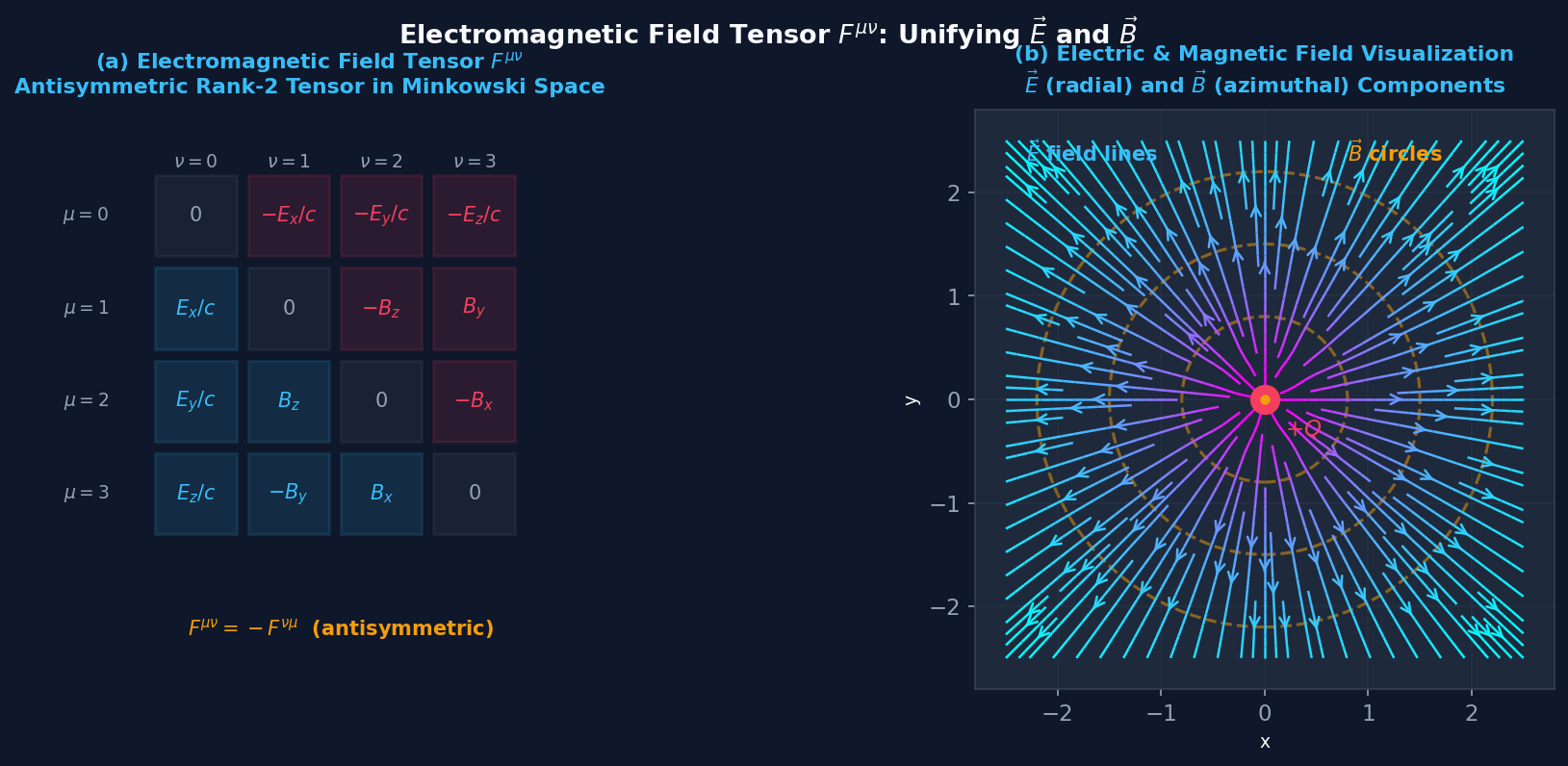
Figure 2.5: Electromagnetic Field Tensor $F^{\mu\nu}$: (a) Antisymmetric 4x4 matrix unifying 3 components of $\vec{E}$ and 3 components of $\vec{B}$, (b) Combined field lines under relativistic boost.
Unification of $\vec{E}$ and $\vec{B}$ in 4D Spacetime
In Newtonian physics, the electric field $\vec{E}$ and magnetic field $\vec{B}$ appear as distinct 3-vectors. In Einstein's Special Relativity, however, space and time unify into 4-dimensional Minkowski spacetime. $\vec{E}$ and $\vec{B}$ are not independent physical vectors, but are simply different components of a single, unified antisymmetric rank-2 tensor: the Faraday electromagnetic field tensor $F^{\mu\nu}$.
1. The Faraday Tensor $F^{\mu\nu}$
From the 4-potential $A^\mu = (\Phi/c, \vec{A})$, the field-strength tensor is defined as the 4-dimensional curl:
Notice that $F^{\mu\nu}$ is strictly antisymmetric ($F^{\mu\nu} = -F^{\nu\mu}$), having $4 \times 3 / 2 = 6$ independent components: exactly 3 electric components $E_i/c$ and 3 magnetic components $B_i$.
2. Lorentz Transformation of Fields
Under a Lorentz boost along the $x$-axis with velocity $v = \beta c$ ($\gamma = 1/\sqrt{1 - \beta^2}$), the tensor transforms as $F'^{\mu\nu} = \Lambda^\mu_\alpha \Lambda^\nu_\beta F^{\alpha\beta}$:
Profound Physical Consequence: A charge at rest in frame $S$ produces only an electrostatic field $\vec{E}$. To an observer moving relative to this charge in frame $S'$, the same charge is a moving current that generates a magnetic field $\vec{B}'$! Thus, magnetism is fundamentally a relativistic consequence of electrostatics.
3. Relativistic Field Invariants
Just as proper time $d\tau$ is invariant, there are two fundamental Lorentz scalar invariants constructed by contracting $F^{\mu\nu}$:
• If $\vec{E} \perp \vec{B}$ and $|\vec{E}| = c|\vec{B}|$ in one inertial frame (like an EM wave in vacuum), then $I_1 = 0$ and $I_2 = 0$ in every inertial frame.
• If $|\vec{E}| < c|\vec{B}|$ ($I_1 > 0$), there exists a reference frame where the electric field vanishes completely ($\vec{E}' = 0$).
• If $|\vec{E}| > c|\vec{B}|$ ($I_1 < 0$), there exists a frame where the magnetic field vanishes completely ($\vec{B}' = 0$).
Physics Problem - Relativistic Particle in Crossed E x B Fields & Lorentz Invariants (E < cB vs E > cB)
Interactive Physics Ready
Click "Run Code" to launch simulation and interactive parameter sliders.
Mathematical Problem Formulation
Theoretical Background & Explanation
Relativistic Dynamics in Crossed $\vec{E} \times \vec{B}$ Fields
A charged particle of rest mass $m$ and charge $q$ is released from rest at the origin in mutually perpendicular uniform fields $\vec{E} = (0, E_y, 0)$ and $\vec{B} = (0, 0, B_z)$. By evaluating the relativistic field invariant $I_1 = 2(B^2 - E^2/c^2)$, analyze the particle's cycloidal trajectory and determine the reference frame where the electric field vanishes.
1. Relativistic Equations of Motion
The relativistic Lorentz force equation is:
2. The Three Field Invariant Regimes
The nature of particle motion is strictly dictated by the invariant $I_1 = 2(B^2 - E^2/c^2)$:
Regime 1: Magnetic-Dominant ($E < c B \implies I_1 > 0$):
There exists a moving reference frame $S'$ boosted along the $x$-axis with velocity: $$\vec{v}_d = \frac{\vec{E} \times \vec{B}}{B^2} = \left(\frac{E_y}{B_z}\right)\hat{i} < c$$ In frame $S'$, the electric field transforms to exactly zero: $\vec{E}' = 0$! The particle simply executes pure circular cyclotron motion in frame $S'$, which transforms to a periodic cycloidal drift in the laboratory frame.Regime 2: Null / Light-Like Field ($E = c B \implies I_1 = 0$):
No rest frame exists where either field vanishes. The particle follows a semi-parabolic trajectory accelerating asymptotically toward the speed of light.Regime 3: Electric-Dominant ($E > c B \implies I_1 < 0$):
There exists a frame where the magnetic field vanishes ($\vec{B}' = 0$). The particle experiences unbounded relativistic hyperbolic acceleration along $\vec{E}$.3. Physical Applications
$\vec{E} \times \vec{B}$ drift is fundamentally independent of both charge and mass (both electrons and ions drift in the exact same direction with velocity $\vec{v}_d = \frac{\vec{E}\times\vec{B}}{B^2}$).
This principle underlies:
• Wien Velocity Filters: Used in mass spectrometers to select charged particles with exact velocity $v = E/B$.
• Magnetron Microwave Generators: Found in radar systems and microwave ovens.
• Hall Effect Thrusters: Advanced ion propulsion for deep space probes and satellites.
• Tokamak Plasma Confinement: Guiding center drift in magnetic fusion reactors.