Cauchy Stress Tensor & Mohr's Circle 2D/3D Studio - Traction Vectors, Principal Stresses, and Maximum In-Plane Shear
Interactive Physics Ready
Click "Run Code" to launch simulation and interactive parameter sliders.
Mathematical Problem Formulation
Theoretical Background & Explanation
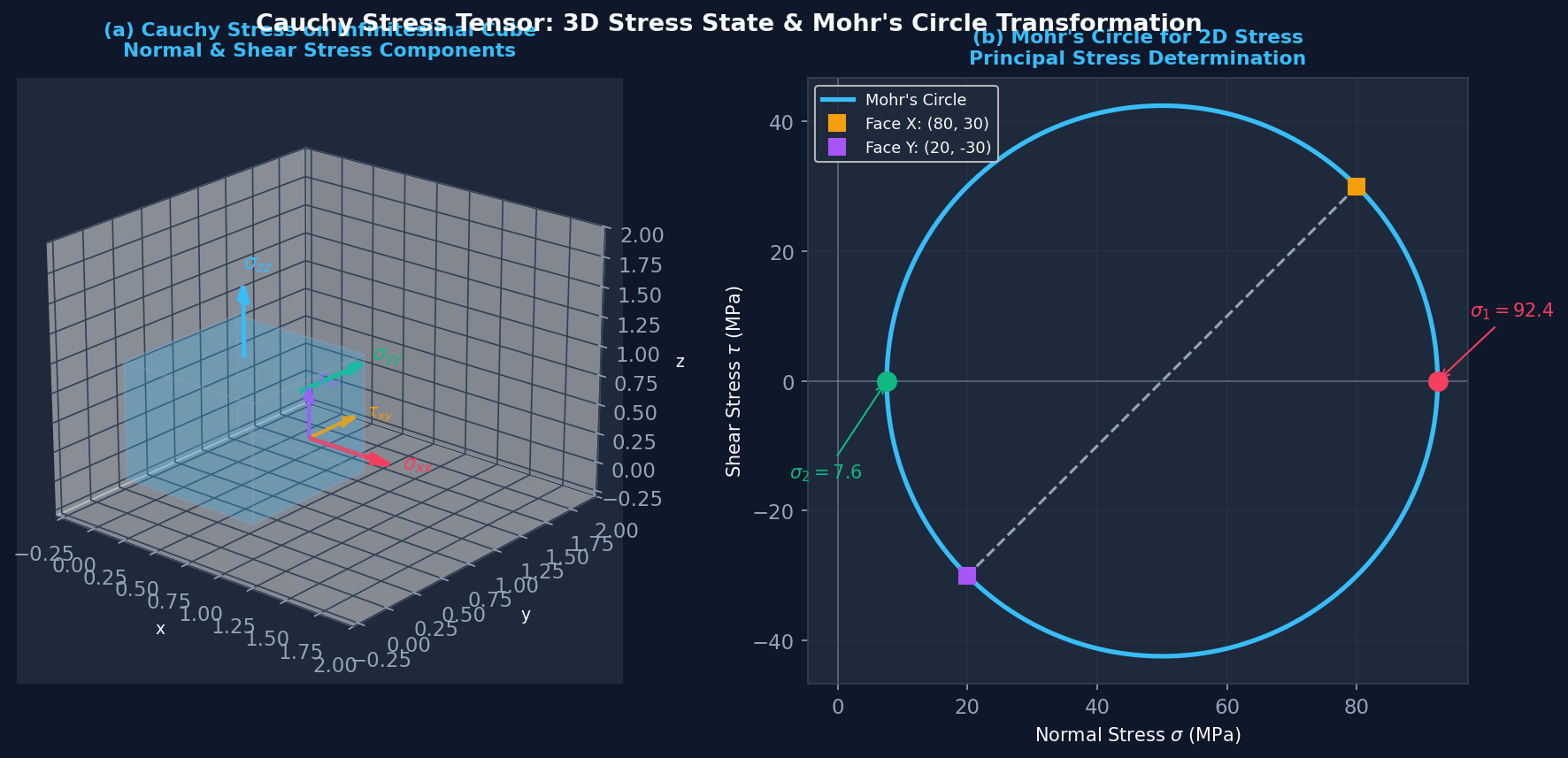
Figure 2.2: Cauchy Stress Tensor & Mohr's Circle: (a) Traction vector $\vec{T}^{(\hat{n})} = [\sigma]\hat{n}$ on an inclined cut plane, (b) Graphical Mohr's circle mapping normal stress $\sigma_n$ and shear stress $\tau_n$ with principal axes $\sigma_1, \sigma_2$.
The Cauchy Stress Principle
When external forces act on a deformable body, internal contact forces are transmitted across any imaginary surface dividing the body. The Cauchy stress tensor $[\sigma]$ is a symmetric rank-2 tensor whose matrix components represent the force per unit area acting on coordinate planes.
1. Traction Vector on an Arbitrary Cut Plane
For a plane defined by outward unit normal $\hat{n} = (n_x, n_y, n_z)^T$, the surface force density (traction vector) $\vec{T}^{(\hat{n})}$ is given by the Cauchy formula:
Conservation of angular momentum requires the stress tensor to be symmetric: $\sigma_{ij} = \sigma_{ji}$ (in the absence of body couples).
2. Normal & Shear Components on an Inclined Plane (2D State)
For a 2D plane stress state with plane normal $\hat{n} = (\cos\theta, \sin\theta)^T$:
3. Mohr's Circle Derivation & Principal Stresses
Squaring and adding the expressions for $(\sigma_n - \sigma_{\text{avg}})$ and $\tau_n$ yields the equation of a circle:
Principal Values:
• Principal Stresses ($\tau_n = 0$): $\sigma_1 = \sigma_{\text{avg}} + R, \quad \sigma_2 = \sigma_{\text{avg}} - R$.
• Maximum Shear Stress: $\tau_{\max} = R = \frac{\sigma_1 - \sigma_2}{2}$ (occurs at $\pm 45^\circ$ to principal axes).
• Principal Orientation: $\tan 2\theta_p = \frac{2\tau_{xy}}{\sigma_x - \sigma_y}$.
Physics Problem - Hydrostatic vs
Interactive Physics Ready
Click "Run Code" to launch simulation and interactive parameter sliders.
Mathematical Problem Formulation
Theoretical Background & Explanation
Engineering Physics Problem: Multi-Axial Yield Failure
A ductile structural steel component is subjected to simultaneous bi-axial normal stresses ($\sigma_x, \sigma_y$) and in-plane shear $\tau_{xy}$. Isotropic metals do not yield under purely hydrostatic pressure (even at thousands of atmospheres at the bottom of the Mariana Trench), but rather yield due to shape distortion governed by the deviatoric stress tensor. Decompose the stress tensor into volumetric and distortional parts and compute the Von Mises safety factor against plastic yield.
1. Tensor Decomposition: Hydrostatic vs. Deviatoric
Any symmetric stress tensor $\sigma_{ij}$ can be uniquely decomposed into a spherical (hydrostatic) part and a trace-free deviatoric part:
Physical Roles:
• $p\,\delta_{ij}$ (Spherical): Produces purely volumetric dilatation or contraction ($\Delta V / V$) with zero shear distortion. Does not cause dislocation slip in crystalline metals.
• $s_{ij}$ (Deviatoric): Produces pure isochoric shape distortion and shear strains, directly driving irreversible plastic deformation.
2. Second Invariant $J_2$ & Von Mises Yield Criterion
The second invariant of the deviatoric stress tensor $J_2$ quantifies the total shear strain energy density:
The Von Mises equivalent stress $\sigma_{\text{vM}}$ is defined such that in uniaxial tension ($\sigma_1 = \sigma_Y, \sigma_2 = \sigma_3 = 0$), $\sigma_{\text{vM}} = \sigma_Y$:
For plane stress ($\sigma_3 = 0$), the yield condition $\sigma_{\text{vM}} = \sigma_Y$ forms the classic ellipse in $(\sigma_1, \sigma_2)$ space: $$\sigma_1^2 - \sigma_1\sigma_2 + \sigma_2^2 = \sigma_Y^2$$ The material remains elastic if $\sigma_{\text{vM}} < \sigma_Y$ with safety factor $\text{SF} = \sigma_Y / \sigma_{\text{vM}}$.